Treatment Policy
|
|
How Disease Develops
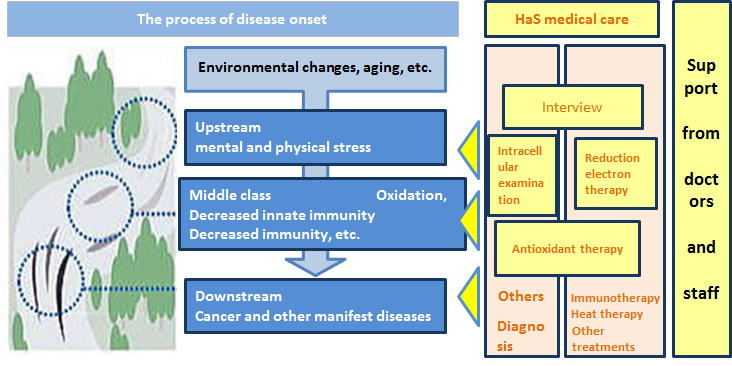
The process by which disease develops can be compared to the flow of a river.
Excessive physical and mental stress is the trigger. (Upstream)
As stress increases, the body's temperature reliably drops (hypothermia), oxygen transport deteriorates (hypoxia), and the internal oxidative-acidic state intensifies (waste products accumulate).
As a result, cellular function declines and immune function is reduced. (Midstream)
When this state persists, chronic diseases such as cancer begin to manifest. (Downstream)
Conventional medicine has focused primarily on the downstream stage. Because attention is concentrated there, it has paradoxically led to increased stress upstream, further intensifying the oxidative environment midstream and worsening the condition.
It is critically important to address not only the downstream stage, but also the midstream and upstream simultaneously. This is the root treatment and causal therapy we aim for.
HaS Shimabukuro Clinic is able to address upstream, midstream, and downstream stages. To provide care across the full spectrum of the disease process, and to offer treatment tailored to each patient's physical, mental, and financial circumstances, we provide a diverse range of treatment options from upstream to downstream.
For the upstream stage, through consultations with patients and families who are prone to anxiety, we work alongside them with the director's cancer philosophy as a foundation, offering emotional and psychological support throughout treatment.
For the midstream stage, we incorporate a wide variety of antioxidant therapies beginning with reductive electron therapy (supplying electrons that are lacking in the body).
Addressing this oxidative state is critically important for enhancing the body's innate healing power (natural restorative ability). We often hear stories of someone recovering from an illness or even cancer through some particular method — we do not dismiss these. In most cases, they represent a form of antioxidant therapy. In other words, by improving the oxidative state midstream, immune function is enhanced — and this understanding flows naturally from our model.
For the manifest cancer lesions downstream, we discuss strategies involving surgery, chemotherapy, and radiation therapy, and additionally provide immunotherapy such as cancer hyperthermia, dendritic cell therapy, vaccine therapy, and activated lymphocyte therapy. At affiliated hospitals, the director may also perform surgery directly.
By skillfully combining these upstream, midstream, and downstream approaches in a balanced way, we can expect a synergistic effect in treatment.
|
|